Art and Transcending the Brevity of Life
Narcissus and GoldmundArt and Transcending the Brevity of Life names the central artistic problem Goldmund confronts: how to preserve the passing world in lasting form without turning away from life in order to do so. His answer is neither simple faith in art’s permanence nor rejection of artistic discipline. Art can carry memory beyond an individual life, yet its making demands renewed sacrifice, and no finished work can fully contain the living experience from which it arose.
Memory, Mortality, and the Need to Create
Goldmund’s need to make something begins with an awareness of how much of his life exists only in memory. Looking out across the valley, he recalls the forests, towns, villages, castles, cloisters, and people scattered along his years of wandering. Some are dead; others, including Robert and Rebekka, may still be alive, though he does not know their fate. Lene’s remains lie somewhere in the distance, as do Viktor’s, while Mariabronn and the knight’s castle belong to the remembered geography of his past. These places and relationships persist within him as love, repentance, and longing, but he fears that death will make the whole inward world disappear.
He thinks of that inward store as a picture book of women and love, summer mornings and winter nights. Very little has survived from his wandering life in a form others can encounter: a few figures made in a workshop, above all his Saint John, and the images carried in his mind. The contrast gives artistic creation an urgent purpose. Goldmund wants to save fragments of that inner world and make them visible, rather than let new landscapes and experiences accumulate without leaving anything behind.
Yet the problem is not simply how to create a monument. Goldmund sees two inadequate alternatives. One is to live through the senses, drawing fullness from life while remaining as vulnerable to death as anything that flourishes briefly in nature. The other is to devote oneself to work that endures, resisting transience by restricting life; in his view, that defense can make the maker a mere instrument and cost him freedom and vitality. He associates this loss with Master Niklaus. Goldmund’s aspiration is to join what those alternatives divide: to create without sacrificing the senses, and to live without giving up the dignity of creation.
Art as Preservation and Transformation
Goldmund’s own turn toward art began after years of wandering. In a cloister church he saw a wooden Madonna whose beauty moved him so strongly that he sought out its maker. The sculptor was a celebrated master, and Goldmund became his apprentice, working with him for several years. This encounter makes art an answer to mortality not only in theory but in the course of Goldmund’s life: an artwork’s beauty draws him toward the practice through which he hopes to give form to what would otherwise pass away.
Goldmund describes art as an overcoming of the transitory. Works of art may themselves burn, crumble, or be destroyed, but they can outlast many human lives, forming a lasting realm of images and relics beyond the moment of their creation. Their endurance is relative, not absolute. Art does not abolish death; it makes something of mortal experience persist longer than the life that first held it.
Narcissus welcomes Goldmund’s return to sculpture and offers to establish a workshop for him at Mariabronn, where the cloister has long lacked an artist. But Narcissus challenges the idea that art is only a way of salvaging a mortal person by preserving that person’s visible form in stone, wood, or color. The deepest image in a work, he suggests, cannot always be reduced to a copy of a particular living model. Goldmund agrees: a real figure may inspire a work, but its basic image is not flesh and blood. It is an image with its home in the artist’s soul, one that the artist must bring into expression.
The exchange distinguishes artistic creation from faithful imitation without severing it from the sensory world. Goldmund’s images are inward, but the material world and living figures can inspire them; the work gives those images a form others can see. For Narcissus, Goldmund’s way of making is bound to his refusal to look away from the world. Where the thinker moves from concrete things toward abstraction, the artist takes mortal things to heart and re-creates them. In Narcissus’s account, this loving attention raises creation into a parable of eternity, though, like intellectual effort, art remains human and imperfect.
The Refectory Work and Its Inner Order
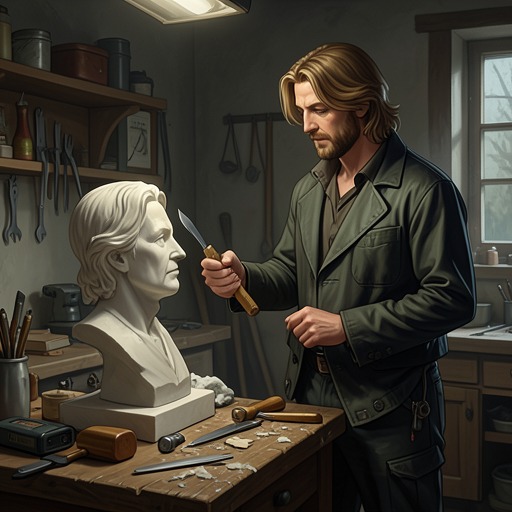
At Mariabronn, Goldmund’s first commission grows from the life and architecture of the cloister rather than from a wish to make an isolated object. He would have preferred an altar or pulpit, but the house had no need or room for either. Instead, he chose the unadorned raised niche in the refectory, where a young brother read from the lives of the saints during meals. Goldmund proposed carved wooden panels for the steps and lectern, with figures in half-relief and others nearly free-standing. The Abbot approved the plan.
The commission gives Goldmund’s theory a concrete setting. The carving is meant to belong to a place where the brothers eat and listen, and to join the existing architecture and works of the cloister as part of a whole. Once he can begin, after snow has fallen and Christmas has passed, his daily life changes. He withdraws from the students and his customary walks, takes his meals at the mill, and restricts access to the workshop to Erich, his assistant. The sustained isolation of the work contrasts with the earlier wandering from which Goldmund gathered his store of images.
As the carving advances, a small world seems to grow from the spiral of the stairs: plants, animals, and people, with Noah among grape leaves and grapes. The panels become a picture book praising the beauty of creation. Their expression is free, yet held together by inner order and discipline. Goldmund’s work thus joins qualities he had feared were incompatible: sensory abundance and formal organization. Erich assists with small tasks and, when Goldmund allows, receives instruction and tries the work himself. Goldmund hopes that, if the project succeeds, Erich’s father will permit the young man to become his permanent assistant.
The figures also carry distinct judgments of human character and artistic labor. On his best days, Goldmund works on the evangelists, when the carving feels harmonious and doubts recede. He especially values the figure bearing Abbot Daniel’s traits, whose face radiates kindness and purity. By contrast, the figure of Master Niklaus appears to him full of discord and sadness. It holds together lofty creative plans and a painful awareness that creation cannot achieve everything it seeks; Goldmund reads in it a mourning for lost unity and innocence. Art preserves more than outward likeness here: it can give visible form to conflicting states of mind.
Completion, Emptiness, and Renewed Sacrifice
When the figure of Abbot Daniel is finished, Goldmund places it alone in the light and covers the remaining statues before taking Narcissus to see it. The unveiling of the completed work soon repeats a familiar turn in his experience. The carving passes into public possession: it is installed, seen, judged, and praised. Goldmund receives honor, and Narcissus’s delight in the work warms him, as do the festive meal and the excellent fish and venison served with the house’s oldest wine. Yet praise does not resolve the maker’s private uncertainty. His workshop and heart feel empty, and he no longer knows whether the work was worth what it cost him.
That disappointment does not mean the work has failed to endure or to serve its setting. It reveals the gap between a completed object and the inward labor that made it. Goldmund knows that the finished work cannot include everything he meant to achieve; some of those unrealized aims are not even visible to other people. When the carving is taken from his hands, the public gains an object while he returns to an emptied workspace and to doubts about what remains of his effort.
Narcissus answers that neither man can wholly understand the other’s struggle, but both know that completed work can leave its maker ashamed and require a new beginning. Creation does not deliver a final escape from transience or settle the artist’s conflict once and for all. Its sacrifice has to be made again. This recurring cost is part of the concept’s significance: art preserves mortal images, but the process cannot make the artist’s life immune to loss, dissatisfaction, or the need to begin anew.
Art, Thought, and the World
The conversations between Goldmund and Narcissus frame artistic and intellectual life as different approaches to reality rather than as a simple contest with a single victor. Goldmund envies Narcissus’s apparent calm and detachment, imagining that the thinker is better equipped to resist despair. Narcissus corrects that impression: peace is not a permanent condition but something won again and again, and his own life involves struggle and sacrifice. Goldmund, in turn, insists that Narcissus cannot see all the artist’s struggles, including the emptiness that follows a work’s completion.
Their exchange clarifies why Goldmund cannot conceive of thought without images. Narcissus describes thinking as a movement toward abstraction, away from the sensory, and an effort to construct a purely spiritual world. Goldmund’s art moves in the other direction: it gives itself to mortal things and makes their transience part of the meaning it expresses. Neither approach is complete or free of cost. Narcissus calls art more innocent because it loves and re-creates the world rather than trying to strip away its appearance, but Goldmund does not simply accept that judgment. Their disagreement preserves the unresolved tension at the heart of the concept: art can bring the transient toward a form of eternity, while remaining bound to material life, imperfect achievement, and sacrifice.